What Is a Chatbot and Why Is It Important for Your Website?
What Is a Chatbot and Why Is It Important for Your Website?

Most business websites are passive. A visitor arrives, looks through pages, searches for information and, if they cannot quickly find what they need, may simply leave and go to the next website.
A website chatbot changes that relationship. Instead of forcing visitors to navigate the website according to how the business has organised its information, it gives them the opportunity to simply ask a question.
Modern AI chatbots, which we prefer to call AI Chat Assistants, can do considerably more than answer frequently asked questions. They can engage website visitors, answer questions using information from across the business, capture and qualify leads, provide customer service 24 hours a day and help a business understand what its website visitors actually want.
Quick takeaway
- A chatbot turns a passive website into a more interactive customer experience.
- It can answer questions immediately and help prevent potential customers leaving because they cannot find what they need.
- It can capture and qualify leads and guide visitors towards the appropriate next step.
- It can answer repetitive customer service questions 24/7, reducing pressure on staff.
- The questions visitors ask provide valuable insights into customer needs, website content gaps and potential sales opportunities.
TL;DR
A website chatbot, or modern AI Chat Assistant, helps turn more website visitors into genuine sales opportunities by giving them immediate answers instead of making them search through pages or leave when they cannot find what they need. It can keep potential customers engaged, provide support 24/7, capture and qualify leads, reduce repetitive customer service enquiries and guide visitors towards the right next step.
Just as importantly, chatbot conversations show you what your visitors are actually asking for. Those insights can help you improve your website, customer service, sales process and the AI Assistant itself.
For businesses already spending money attracting visitors to their website, an effective AI Chat Assistant can help get more value from that existing traffic. Even one additional converted lead may be enough to justify the investment.
What is a chatbot?
A chatbot is a software application that allows people to interact with a business or system through a conversation.
Traditional chatbots generally followed predefined rules, keywords and scripted conversation flows. They could be useful, but they were often limited. If a customer asked something outside the expected flow, the chatbot could easily misunderstand the question or provide an unhelpful response.
Modern AI Chat Assistants are different.
They can understand natural-language questions and use AI to determine what a person is asking. When properly trained on business-specific information, they can retrieve relevant knowledge from website pages, FAQs, documents, product information, policies, procedures and other approved sources.
This means a visitor no longer has to know where the information is located.
They can simply ask.
DepthNode, for example, allows businesses to create, train and publish AI Assistants using their own websites, documents, Q&As, images and decision flows. The objective is to ground the AI Assistant in knowledge that is relevant to that particular business rather than relying solely on the general knowledge of an AI model.
What is the difference between a traditional chatbot and an AI Chat Assistant?
The term “chatbot” now describes technologies with very different capabilities.
Traditional chatbots generally follow predefined scripts, buttons, keywords and conversation flows. They work well when the user stays within the anticipated path, but can struggle when someone asks an unexpected question.
Modern AI Chat Assistants can understand natural-language questions, allow visitors to ask questions in their own words, retrieve information from multiple business knowledge sources and adapt the conversation according to what the visitor is trying to achieve.
This distinction matters because many people’s perception of chatbots is still based on older systems that could be frustrating to use.
A good AI Chat Assistant should feel less like navigating another menu and more like asking the business a question.
Why is a chatbot important for a website?
A conventional website relies heavily on the visitor doing the work.
The business decides how information is divided into pages, menus and sections. The visitor then needs to understand that structure, find the right page, read through it and identify the information relevant to them.
That works when the visitor can easily find what they need.
But what happens when they cannot?
In our experience, many visitors will look around for a while and then leave. The next business is only another search result or browser tab away.
An AI Chat Assistant provides another opportunity to help that visitor before they leave your website.
They might ask:
- Do you provide this particular service?
- How much does it cost?
- Are you available in my area?
- Which product is suitable for me?
- When are you open?
- How does your service work?
- Am I eligible?
- Can somebody contact me?
- What should I do next?
Importantly, the answer may need information from several different parts of the website or from business information that is not publicly displayed on the website at all.
A properly trained AI Chat Assistant can bring that information together into a useful response.
A chatbot can help turn website traffic into opportunities
Businesses spend considerable amounts of money getting people to their websites.
Search engine optimisation, Google Ads, social media, radio, email campaigns, sponsorships and other marketing activities all have the same fundamental objective: get the attention of a potential customer and encourage them to take the next step.
Imagine a business spending $10,000 a month on advertising that generates website traffic.
A potential customer arrives with a genuine question. They cannot immediately find the answer. There is a contact form, an email address and a telephone number, but they do not want to wait or call during business hours.
So they leave.
If a relatively inexpensive AI Chat Assistant could answer the question, keep that person engaged and convert even one additional visitor into a valuable paying customer, the economics can become compelling.
The important question is therefore not simply:
“How much does a chatbot cost?”
It is also:
“What is a qualified website visitor worth to my business, and how many opportunities am I currently losing?”
Research supports the broader principle that conversational engagement can affect conversion. Research published in Production and Operations Management found that live chat positively affected traffic-to-sales conversion, particularly where information on the website was less comprehensive. The researchers identified both informing and persuading customers as mechanisms through which conversational interaction can influence conversion.
More recent B2B research published in the Journal of Business Research compared conversational chatbots with conventional landing pages. Across two field experiments involving more than 16,000 participants, the researchers found that the chatbot approach generated significantly more leads and higher-quality leads. Responsiveness and personalised interaction were among the factors associated with the results.
The precise result will vary enormously between businesses, products and customer journeys, so businesses should be wary of generic claims that “a chatbot increases conversion by X per cent”.
The more useful principle is simple:
When a potential customer has a question, providing a relevant answer immediately removes one source of friction from the buying journey.
A chatbot can capture and qualify leads
Answering questions is only the beginning.
An AI Chat Assistant can be designed around the organisation’s existing sales process.
For example, the assistant might first identify what the visitor wants. Depending on the answer, it could:
- provide the requested information;
- ask additional qualifying questions;
- recommend an appropriate service or next step;
- collect the visitor’s contact details;
- offer a consultation or demonstration;
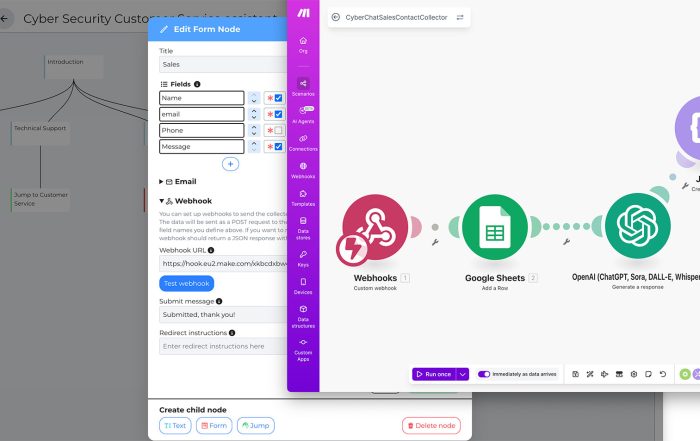
- pass the information to another business system; or
- trigger an automation for follow-up.
The important distinction is that the visitor does not necessarily have to follow one rigid path.
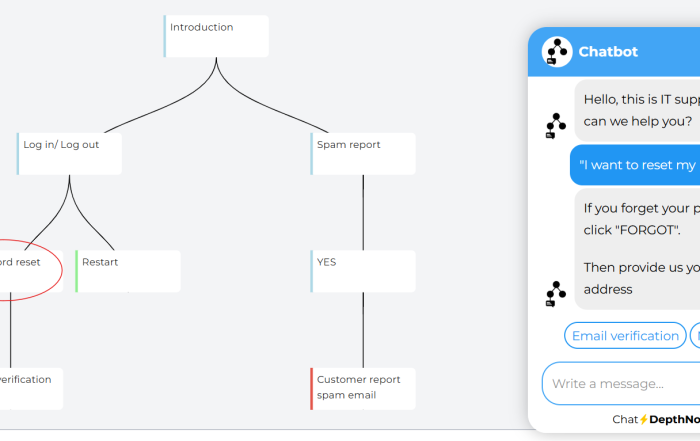
AI can interpret what the visitor is trying to achieve and offer an appropriate route, while structured decision logic can still be used where the business needs greater control.
For example, a visitor asking about a particular service might be asked two or three relevant questions. Their answers could indicate that they are a genuine prospective customer, at which point the assistant can offer to collect their details for follow-up.
The conversation has moved naturally from question → answer → qualification → lead.
Why immediate answers matter
There is an important difference between asking a question and completing a contact form.
When someone asks a question, they are expressing an information need right now.
A traditional contact form effectively says: give us your information and somebody may respond later.
An AI Chat Assistant can potentially respond immediately.
Research into online lead handling has long demonstrated the importance of responsiveness. Research reported by Harvard Business Review found substantial differences in how quickly businesses responded to online leads, reinforcing the importance of responding while a potential customer is actively interested.
An AI Chat Assistant does not replace a salesperson, but it can remove the delay from the first interaction.
That can be particularly valuable outside normal business hours.
Your customers do not necessarily work your hours
Twenty-four-hour availability is becoming increasingly important.
People work shifts, run their own businesses, manage families and increasingly expect to access information when it suits them.
Someone researching a service at 9.30 pm may have no intention of making a telephone call. They may not want to send an email and wait until tomorrow either.
An AI Chat Assistant can still help them.
It can answer a question, explain a service, collect their details or guide them towards an appropriate next step.
The business does not need to have customer service staff sitting behind a live chat window around the clock to provide that first level of assistance.
Can a chatbot reduce customer service workload?
Yes, particularly where staff repeatedly answer the same questions.
Once an AI Chat Assistant has been properly trained on the organisation’s common questions and relevant business information, many routine enquiries can be handled automatically.
That could include questions about:
- products and services;
- pricing;
- availability;
- opening hours;
- processes;
- policies;
- locations;
- eligibility;
- common support issues; and
- what the customer should do next.
Our view at DepthNode is not that AI should simply replace customer service staff.
The more useful objective is to allow a business to do more with the same headcount.
If AI can deal with routine, repetitive questions, employees can concentrate on complex enquiries, valuable customers, exceptions and conversations where human judgement actually adds value.
One of the biggest benefits is often overlooked: customer insight
Perhaps the most underestimated benefit of a website chatbot is not what it tells your customers.
It is what your customers tell you.
Every genuine question provides information about what visitors want, what they cannot find and what matters to them.
At DepthNode, we regularly review conversation histories. They almost always reveal questions we did not anticipate.
That information can be used to:
- improve the AI Assistant’s training;
- identify questions it is not answering properly;
- correct inaccurate or unhelpful responses;
- improve website content;
- identify information visitors are struggling to find;
- understand which products or services generate interest;
- improve customer service processes;
- refine sales pathways; and
- identify potential new business opportunities.
This creates a feedback loop:
Visitor asks → AI responds → business reviews → business learns → website and AI improve.
This ability to learn from customer conversations is one of the reasons we see an AI Chat Assistant as more than simply another customer service channel.
What we learnt from NECA Victoria
A practical example comes from the implementation of a DepthNode AI Chat Assistant for NECA Victoria.
NECA Victoria provides a broad range of information, services and resources for electrical contractors. One objective of its AI Chat Assistant was to make it easier for members and website visitors to find relevant information.
When the conversations were analysed, an important pattern emerged: more than 60% of the website questions being asked through the assistant related to training and education.
That is useful business intelligence.
Without analysing the conversations, the organisation might know how many people visited particular pages, but the questions provide another layer of information. They reveal, in the visitor’s own terms, what people are actively trying to find out.
This is why we believe a website AI Chat Assistant should not be viewed purely as a customer service tool.
It can also become a listening tool for the business.
Chatbot conversations can show you what is wrong with your website
There is another useful consequence of reviewing these conversations.
If people repeatedly ask a question that is already answered somewhere on the website, there may be nothing wrong with the information itself.
The problem may be that people cannot find it.
That distinction matters.
Website analytics can tell you which pages people visited and how long they stayed. Chatbot conversations can help explain what they were actually trying to accomplish.
A recurring question might indicate that:
- an important page is difficult to find;
- navigation is confusing;
- a service description is unclear;
- pricing information needs clarification;
- an FAQ is missing;
- customers use different terminology from the business;
- an important next step is not obvious; or
- visitors are interested in something the business has not adequately addressed.
In that sense, your chatbot can become an ongoing source of website research.
What makes a bad chatbot?
There is a legitimate reason some business owners are cautious about chatbots.
Bad chatbots are frustrating.
They force users down predetermined paths, misunderstand questions, provide irrelevant responses or repeatedly give the same answer even though it clearly has not helped.
That can make the customer experience worse rather than better.
Modern AI does not automatically eliminate that problem.
A useful AI Chat Assistant still needs to be designed, trained, tested and reviewed.
In practical terms, that means:
- training it on relevant business-specific knowledge;
- providing clear instructions about how it should behave;
- grounding answers in approved business information;
- testing it using realistic customer questions;
- deciding what it should and should not answer;
- defining lead qualification and customer service pathways;
- providing sensible alternatives when it cannot answer;
- reviewing conversation history; and
- continually improving the knowledge and instructions.
DepthNode’s own approach allows an assistant to be trained using website content and other business knowledge so that responses are based on relevant organisational information rather than a generic AI conversation.
Putting an AI chat window on a website is easy. Making it genuinely useful is the important part.
If a business does not have the time or expertise to configure this itself, a professionally configured AI Assistant can be built and trained around the business, including its website content, FAQs, services, customer questions, lead capture requirements and desired conversation pathways.
What should happen when the AI cannot answer?
No AI Assistant should be expected to know everything.
If the assistant does not have sufficient business context to answer a question appropriately, the safer approach is to acknowledge that limitation rather than invent an answer.
Depending on the business, it might then:
- ask the visitor to rephrase the question;
- present quick-reply options;
- suggest related areas it can help with;
- collect information for human follow-up;
- provide appropriate contact information; or
- continue the conversation if the visitor asks a related question.
The correct fallback behaviour should be designed around the business.
This is one reason grounding the assistant in business-specific information is so important. Rather than relying solely on the general knowledge of an AI model, the assistant can retrieve information from material supplied or approved by the organisation.
That improves relevance and gives the business greater control over what the assistant is expected to know.
Should every website have a chatbot?
Not necessarily.
Adding a chatbot simply because “everyone is using AI” is not a good business case.
The stronger case exists when a website:
- receives meaningful visitor traffic;
- generates enquiries or sales leads;
- contains substantial information;
- has products or services that generate questions;
- receives repetitive customer service enquiries;
- operates in a market where customers research outside normal hours;
- spends money attracting visitors through advertising or marketing;
- wants to improve lead capture; or
- wants better insight into what website visitors actually want.
The higher the value of a customer or lead, the easier it can be to justify the investment.
A business does not need hundreds of additional conversions for an AI Chat Assistant to create value. Depending on the economics of the business, one additional converted customer may be enough to pay for the service many times over.
For businesses assessing the economics, DepthNode offers AI Assistant plans ranging from free testing through to business and enterprise options.
Our view: a chatbot should do more than answer questions
At DepthNode, we believe the real value of an AI Chat Assistant comes from combining five functions:
1. Engage
Give visitors a simple way to ask what they want instead of forcing them to search.
2. Answer
Use business-specific knowledge to provide useful, relevant responses.
3. Guide and convert
Help visitors determine the next step, qualify genuine prospects and capture leads where appropriate.
4. Support
Handle repetitive enquiries and provide access to information 24 hours a day.
5. Learn
Analyse the questions people ask to understand customers better and continuously improve the website, AI Assistant and business.
That is a much broader role than the traditional chatbot.
And chat does not have to be the end of the journey
Once a business has developed useful AI knowledge, instructions and conversational processes, the same approach can extend beyond the website.
For example, AI Voice Agents can bring conversational AI to the telephone, answering inbound calls, handling enquiries and supporting other telephone-based customer interactions.
Automations can also connect conversations to other systems and workflows.
The website AI Chat Assistant can therefore be a practical first step in a broader AI implementation rather than an isolated piece of technology.
Frequently asked questions
What is a website chatbot?
A website chatbot is software that allows visitors to interact with a business through a conversational interface. Modern AI chatbots can understand natural-language questions and, when properly trained, provide answers using business-specific information.
What is an AI Chat Assistant?
An AI Chat Assistant is a modern form of chatbot that uses artificial intelligence to understand questions and generate relevant responses. It can be trained on website content, FAQs, documents and other approved business knowledge, and can also guide users through defined processes.
Can a chatbot generate leads?
Yes. A chatbot can answer pre-sales questions, identify what a visitor wants, ask qualifying questions, collect contact details and guide suitable prospects towards a consultation, demonstration, purchase or other sales action.
Can a chatbot improve website conversion?
Conversational interaction can remove friction by answering questions when a visitor has them. Research has found positive effects from conversational channels on sales conversion and B2B lead generation, although results depend on the business, customer journey and quality of implementation.
Can a chatbot replace customer service staff?
It can automate many repetitive enquiries, but replacing staff entirely should not be the objective for most businesses. A more practical model is to use AI for routine questions and first-line assistance while allowing staff to concentrate on complex or higher-value interactions.
Can a chatbot answer questions outside business hours?
Yes. An AI Chat Assistant can operate 24 hours a day, allowing customers and prospects to access information when the business itself may be closed.
How does a chatbot know about my business?
A business-specific AI Chat Assistant can be trained on approved information such as website content, FAQs, documents, product and service information, policies and procedures. Keeping this information accurate and current is an important part of maintaining the assistant.
What can a business learn from chatbot conversations?
Conversation history can reveal frequently asked questions, customer interests, missing information, confusing website content, demand for particular services and areas where visitors may be getting stuck. This makes the chatbot a source of business insight as well as a customer service channel.
Ready to see what an AI Chat Assistant could do for your website?
A chatbot provides one more way for your business to take care of customers and prospects. It can keep someone on your website for that little bit longer, answer the question that might otherwise make them leave, capture a valuable lead and show you what your visitors actually want.
DepthNode helps Australian businesses create, train and publish AI Chat Assistants using their own business knowledge. You can explore the DepthNode AI platform and build your own assistant, or use our Built For You service if you would prefer us to design, train and configure it for your business.
The objective is simple: help more of the people who already arrive at your website get what they need, and give your business a better opportunity to turn those visits into customers.